History
Ford of Europe was founded in 1967 on the merger of the British and German divisions of the Ford Motor Company. The front-engined Ford Transit range of panel vans launched in 1965, was the first formal co-operation between the two entities, simultaneously developed to replace the German Ford Taunus Transit and the British Ford Thames 400E. Prior to this, the two companies avoided marketing their vehicles in one another's domestic markets, and in much of the rest of western Europe were direct competitors, with totally separate product lines, despite being owned by the same American parent, in a similar manner to General Motors’ Opel and Vauxhall subsidiaries at the same time - indeed GM followed Ford's precedent in the 1970s by merging the operations of Opel and Vauxhall into General Motors Europe.
1967–1973: Cortina and Escort
The first new model launched after the creation of Ford of Europe was the Escort built in England from October 1967, and launched to market later that year. The Escort was a rear-wheel drive small family saloon that took the place of the British Anglia range and was built in both Britain and, from 1970, Germany. It was first available as a two-door saloon and later in estate, van and four-door saloon bodystyles. Power came from 950 cc, 1100 cc and 1300 cc petrol engines. Later there was also a 2000 cc unit which came in the RS2000 performance version and was capable of 110 mph (180 km/h). It quickly became popular with buyers, outselling in the UK key competitors from BMC (later British Leyland), Vauxhall (Opel in Germany) and the Rootes Group. The Escort would never achieve such dominance in Europe's largest auto market, but nevertheless took significant market share from the Opel and Volkswagen competitors of the time.
Ford Europe's second new car launch was the Capri sporting coupé in 1969. Loosely based on Ford UK's rear-wheel drive Mk II Cortina platform, it came with engines ranging from 1300 cc to 3000 cc and was made in Britain and Germany (with a different range of German V4 and V6 engines), and quickly became popular with buyers who wanted something different from BMC's MGB GT and the Rootes Group's Sunbeam Alpine.
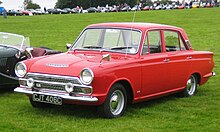
August 1970 saw the launch of the British Ford Cortina Mk III and its German cousin, a the Taunus (replacing the Taunus 12M & 15M). The British and German models were based on the same platform, but had different sheet metal and used engines from their home countries, though both models could be had with the new German-built 2000cc OHC petrol engine. By 1972 the Cortina was the best-selling car in Britain.In the Spring of 1972, Ford Europe replaced their top of the range models from Britain (Zephyr/Zodiac) and Germany (17M/20M/26M) with the Consul and Granada (large sedan, estate and coupé) which was aimed directly at the Opel Rekord, Rover P6, Audi 100 and Triumph 2000. It quickly outsold its rivals in many countries and in 1973 was the tenth best-selling car in Britain. Like the Capri and Cortina/Taunus models, the early Consuls and Granadas were built in both Britain and Germany, each with a unique range of national engines.
1974–1980: MK 2 Escort and New Fiesta
A revised Capri II arrived in early 1974, which saw a hatchback replacing the traditional "boot".
Ford launched a Ford Escort (Europe) at the start of 1975, with a heavily restyled exterior and a less cramped interior, but an almost identical mechanical design. The entry-level 950 cc engine, which was rare in any country, was discontinued.
In 1975, Ford overtook British Leyland (the combine which included Austin, Morris and Rover) as the most popular make of car in the United Kingdom.
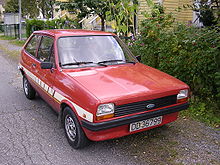
1976 saw Ford Europe enter the mini-car market with its first ever-front model to have a hatchback and front-wheel drive. The Fiesta MK1 was built at the company's new Valencia plant in Spain, and came with 950 cc, 1100 cc and 1300 cc petrol engines. It was later available with a 1600 cc unit for the sporty XR2 version. Britain and most of the rest of Europe took to it straight away and it was quickly among the best-selling cars in most of the continent, fighting off competition from the Volkswagen Polo, Citroën Visa, Vauxhall Chevette and Peugeot 104.
1976 also saw the launch of the Cortina MK4 and Taunus, that continued to top the sales charts in Britain and fight off competition from a growing number of equally competent rivals, namely the Vauxhall Cavalier/Opel Ascona and Chrysler Alpine.
Ford launched the Mk II Granada range in September 1977. In 1976, all Granada production had been concentrated to Cologne, Germany. The Consul badge was abandoned in 1975.
The Mk III Capri sporting coupé arrived in 1978. By now Capri production was also concentrated at Cologne.
1980 saw one of the most important car launches in Ford's history. The MK3 Escort went on sale across Britain and Europe in October, with its ultra-modern styling and updated front-wheel drive mechanical layout. It was also available as a hatchback for the first time, with no saloon version on offer. The 2000 cc engine was dropped, and the range-topping Escort was now the XR3 which came with a fuel-injected 1600 cc unit.

Tidak ada komentar:
Posting Komentar