Sabtu, 26 September 2015

Motorcycle


A 1954 Triumph T110 motorcycle
Motorcycle
A motorcycle (also called a motorbike, bike, moto or cycle) is a two or three wheeled motor vehicle. Motorcycle design varies greatly to suit a range of different purposes: long distance travel, commuting, cruising, sport including racing, and off-road riding. Motorcycling is riding a motorcycle and related social activity such as joining a motorcycle club and attending motorcycle rallies.

In 1894, Hildebrand & Wolfmüller became the first series production motorcycle, and the first to be called a motorcycle. In 2012, the three top motorcycle producers globally by volume were Honda (from Japan), Bajaj Auto, and Hero MotoCorp (both from India).

Motorcycles are mainly a luxury good in the developed world, where they are used mostly for recreation, as a lifestyle accessory or a symbol of personal identity. In developing countries, motorcycles are overwhelmingly utilitarian due to lower prices and greater fuel economy. Of all the motorcycles in the world, 58% are in the Asia Pacific and Southern and Eastern Asia regions, excluding car-centric Japan.
According to the United States Department of Transportation the number of fatalities per vehicle mile traveled was 37 times higher for motorcycles than for cars.


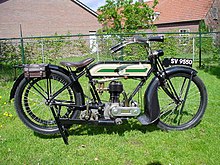
Triumph Motorcycles Model H, mass-produced for the war effort and notable for its reliability
History
Experimentation and invention

The first commercial design for a self-propelled cycle was a three-wheel design called the Butler Petrol Cycle, conceived of Edward Butler in England in 1884. He exhibited his plans for the vehicle at the Stanley Cycle Show in London in 1884. The vehicle was built by the Merryweather Fire Engine company in Greenwich, in 1888.
The Butler Petrol Cycle was a three-wheeled vehicle, with the rear wheel directly driven by a 5/8hp (466W) 600 cc (40 in3; 2¼×5-inch {57×127-mm}) flat twin four stroke engine (with magneto ignition replaced by coil and battery) equipped with rotary valves and a float-fed carburettor (five years before Maybach) and Ackermann steering, all of which were state of the art at the time. Starting was by compressed air. The engine was liquid-cooled, with a radiator over the rear driving wheel. Speed was controlled by means of a throttle valve lever. No braking system was fitted; the vehicle was stopped by raising and lowering the rear driving wheel using a foot-operated lever; the weight of the machine was then borne by two small castor wheels. The driver was seated between the front wheels. It wasn't, however, a success, as Butler failed to find sufficient financial backing.

Another early internal combustion, petroleum fueled motorcycle was the Daimler Reitwagen. It was designed and built by the German inventors Gottlieb Daimler and Wilhelm Maybach in Bad Cannstatt, Germany in 1885. This vehicle was unlike either the safety bicycles or the boneshaker bicycles of the era in that it had zero degrees of steering axis angle and no fork offset, and thus did not use the principles of bicycle and motorcycle dynamics developed nearly 70 years earlier. Instead, it relied on two outrigger wheels to remain upright while turning. The inventors called their invention the Reitwagen ("riding car"). It was designed as an expedient testbed for their new engine, rather than a true prototype vehicle.

Many authorities have excluded steam powered, electric motorcycles or diesel-powered two-wheelers from the definition of a 'motorcycle', and credit the Daimler Reitwagen as the world's first motorcycle. Given the rapid rise in use of electric motorcycles worldwide, defining only internal-combustion powered two-wheelers as 'motorcycles' is increasingly problematic.

If a two-wheeled vehicle with steam propulsion is considered a motorcycle, then the first motorcycles built seem to be the French Michaux-Perreaux steam velocipede which patent application was filled in December 1868, constructed around the same time as the American Roper steam velocipede, built by Sylvester H. Roper Roxbury, Massachusetts, who demonstrated his machine at fairs and circuses in the eastern U.S. in 1867, and built a total of 10 examples.

First motorcycle companies
In 1894, Hildebrand & Wolfmüller became the first series production motorcycle, and the first to be called a motorcycle (German: Motorrad). Excelsior Motor Company, originally a bicycle manufacturing company based in Coventry, England, began production of their first motorcycle model in 1896. The first production motorcycle in the US was the Orient-Aster, built by Charles Metz in 1898 at his factory in Waltham, Massachusetts.

In the early period of motorcycle history, many producers of bicycles adapted their designs to accommodate the new internal combustion engine. As the engines became more powerful and designs outgrew the bicycle origins, the number of motorcycle producers increased. Many of the nineteenth century inventors who worked on early motorcycles often moved on to other inventions. Daimler and Roper, for example, both went on to develop automobiles.

At the turn of the century the first major mass-production firms were set up. In 1898, Triumph Motorcycles in England began producing motorbikes, and by 1903 it was producing over 500 bikes. Other British firms were Royal Enfield, Norton and Birmingham Small Arms Company who began motorbike production in 1899, 1902 and 1910, respectively. Indian began production in 1901 and Harley Davidson was established two years later. By the outbreak of the First World War, the largest motorcycle manufacturer in the world was Indian, producing over 20,000 bikes per year.

First World War
During the First World War, motorbike production was greatly ramped up for the war effort to supply effective communications with front line troops. Messengers on horses were replaced with despatch riders on motorcycles carrying messages, performing reconnaissance personnel and acting as a military police. American company Harley-Davidson was devoting over 50% of its factory output toward military contract by the end of the war. The British company Triumph Motorcycles sold more than 30,000 of its Triumph Type H model to allied forces during the war. With the rear wheel driven by a belt, the Model H was fitted with a 499 cc (30.5 cu in) air-cooled four-stroke single-cylinder engine. It was also the first Triumph without pedals.
The Model H in particular, is regarded by many as having been the first "modern motorcycle". Introduced in 1915 it had a 550 cc side-valve four-stroke engine with a three-speed gearbox and belt transmission. It was so popular with its users that it was nicknamed the "Trusty Triumph.

Postwar
By 1920, Harley-Davidson was the largest manufacturer, with their motorcycles being sold by dealers in 67 countries. By the late 1920s or early 1930s, DKW in Germany took over as the largest manufacturer.

In the 1950s, streamlining began to play an increasing part in the development of racing motorcycles and the "dustbin fairing" held out the possibility of radical changes to motorcycle design. NSU and Moto Guzzi were in the vanguard of this development, both producing very radical designs well ahead of their time. NSU produced the most advanced design, but after the deaths of four NSU riders in the 1954–1956 seasons, they abandoned further development and quit Grand Prix motorcycle racing.

Moto Guzzi produced competitive race machines, and by 1957 nearly all the Grand Prix races were being won by streamlined machines. The following year, 1958, full enclosure fairings were banned from racing by the FIM in the light of the safety concerns.

From the 1960s through the 1990s, small two-stroke motorcycles were popular worldwide, partly as a result of East German Walter Kaaden's engine work in the 1950s.

History of the automobile


Cugnot's steam wagon, the second (1771) version

History of the automobile
The early history of the automobile can be divided into a number of eras, based on the prevalent means of propulsion. Later periods were defined by trends in exterior styling, size, and utility preferences.

In 1768 the first steam powered automobile capable of human transportation was built by Nicolas-Joseph Cugnot.
In 1807, François Isaac de Rivaz designed the first car powered by an internal combustion engine fueled by hydrogen.
In 1886 the first petrol or gasoline powered automobile the Benz Patent-Motorwagen was invented by Karl Benz. This is also considered to be the first "production" vehicle as Benz made several identical copies.

At the turn of the 20th century electrically powered automobiles appeared but only occupied a niche market until the turn of the 21st century.

Early automobiles
Steam-powered wheeled vehicles

17th and 18th centuries

Ferdinand Verbiest, a member of a Jesuit mission in China, built the first steam-powered vehicle around 1672 as a toy for the Chinese Emperor. It was of small enough scale that it could not carry a driver but it was, quite possibly the first working steam-powered vehicle ('auto-mobile').

Steam-powered self-propelled vehicles large enough to transport people and cargo were first devised in the late 18th century. Nicolas-Joseph Cugnot demonstrated his fardier à vapeur ("steam dray"), an experimental steam-driven artillery tractor, in 1770 and 1771. As Cugnot's design proved to be impractical, his invention was not developed in his native France. The center of innovation shifted to Great Britain. By 1784, William Murdoch had built a working model of a steam carriage in Redruth. The first automobile patent in the United States was granted to Oliver Evans in 1789, and in 1801 Richard Trevithick was running a full-sized vehicle on the roads in Camborne.
 
19th century
Many vehicles were in vogue for a time, and over the next decades such innovations as hand brakes, multi-speed transmissions, and better steering developed. Some were commercially successful in providing mass transit, until a backlash against these large speedy vehicles resulted in the passage of the Locomotive Act (1865), which required many self-propelled vehicles on public roads in the United Kingdom to be preceded by a man on foot waving a red flag and blowing a horn. This effectively killed road auto development in the UK for most of the rest of the 19th century; inventors and engineers shifted their efforts to improvements in railway locomotives. (The law was not repealed until 1896, although the need for the red flag was removed in 1878.)

Among other efforts, in 1815, a professor at Prague Polytechnic, Josef Bozek, built an oil-fired steam car. Walter Hancock, builder and operator of London steam buses, in 1838 built a four-seat steam phaeton.
In 1867, Canadian jeweller Henry Seth Taylor demonstrated his 4-wheeled "steam buggy" at the Stanstead Fair in Stanstead, Quebec, and again the following year. The basis of the buggy, which he began building in 1865, was a high-wheeled carriage with bracing to support a two-cylinder steam engine mounted on the floor.
What some people define as the first "real" automobile was produced by French Amédée Bollée in 1873, who built self-propelled steam road vehicles to transport groups of passengers.

The American George B. Selden filed for a patent on May 8, 1879. His application included not only the engine but its use in a 4-wheeled car. Selden filed a series of amendments to his application which stretched out the legal process, resulting in a delay of 16 years before the US 549160 was granted on November 5, 1895.

Karl Benz, the inventor of numerous car-related technologies, received a German patent in 1886.

The four-stroke petrol (gasoline) internal combustion engine that constitutes the most prevalent form of modern automotive propulsion is a creation of Nikolaus Otto. The similar four-stroke diesel engine was invented by Rudolf Diesel. The hydrogen fuel cell, one of the technologies hailed as a replacement for gasoline as an energy source for cars, was discovered in principle by Christian Friedrich Schönbein in 1838. The battery electric car owes its beginnings to Ányos Jedlik, one of the inventors of the electric motor, and Gaston Planté, who invented the lead-acid battery in 1859.

The first carriage-sized automobile suitable for use on existing wagon roads in the United States was a steam powered vehicle invented in 1871, by Dr. J.W. Carhart, a minister of the Methodist Episcopal Church, in Racine, Wisconsin. It induced the State of Wisconsin in 1875, to offer a $10,000 award to the first to produce a practical substitute for the use of horses and other animals. They stipulated that the vehicle would have to maintain an average speed of more than five miles per hour over a 200-mile course. The offer led to the first city to city automobile race in the United States, starting on July 16, 1878, in Green Bay, Wisconsin, and ending in Madison, via Appleton, Oshkosh, Waupun, Watertown, Fort Atkinson, and Janesville. While seven vehicles were registered, only two started to compete: the entries from Green Bay and Oshkosh. The vehicle from Green Bay was faster, but broke down before completing the race. The Oshkosh finished the 201 mile course in 33 hours and 27 minutes, and posted an average speed of six miles per hour. In 1879, the legislature awarded half the prize.
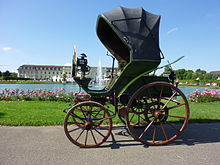
 
German Flocken Elektrowagen of 1888, regarded as the first electric car of the world.


20th and 21st centuriesPre WWII
Steam-powered road vehicles, both cars and wagons, reached the peak of their development in the early 1930s with fast-steaming lightweight boilers and efficient engine designs. Internal combustion engines also developed greatly during WWI, becoming simpler to operate and more reliable. The development of the high-speed diesel engine from 1930 began to replace them for wagons, accelerated by tax changes in the UK making steam wagons uneconomic overnight. Although a few designers continued to advocate steam power, no significant developments in production steam cars took place after Doble in 1931.

Post-WWII

Whether steam cars will ever be reborn in later technological eras remains to be seen. Magazines such as Light Steam Power continued to describe them into the 1980s. The 1950s saw interest in steam-turbine cars powered by small nuclear reactors. (this was also true of aircraft), but the dangers inherent in nuclear fission technology soon killed these ideas.

Electric automobiles
In 1828, Ányos Jedlik, a Hungarian who invented an early type of electric motor, created a tiny model car powered by his new motor. In 1834, Vermont blacksmith Thomas Davenport, the inventor of the first American DC electrical motor, installed his motor in a small model car, which he operated on a short circular electrified track. In 1835, Professor Sibrandus Stratingh of Groningen, the Netherlands and his assistant Christopher Becker created a small-scale electrical car, powered by non-rechargeable primary cells. In 1838, Scotsman Robert Davidson built an electric locomotive that attained a speed of 4 miles per hour (6 km/h). In England, a patent was granted in 1840 for the use of rail tracks as conductors of electric current, and similar American patents were issued to Lilley and Colten in 1847. Between 1832 and 1839 (the exact year is uncertain) Robert Anderson of Scotland invented the first crude electric carriage, powered by non-rechargeable primary cells.

The Flocken Elektrowagen of 1888 by German inventor Andreas Flocken is regarded as the first real electric car of the world.
Electric cars enjoyed popularity between the late 19th century and early 20th century, when electricity was among the preferred methods for automobile propulsion, providing a level of comfort and ease of operation that could not be achieved by the gasoline cars of the time. Advances in internal combustion technology, especially the electric starter, soon rendered this advantage moot; the greater range of gasoline cars, quicker refueling times, and growing petroleum infrastructure, along with the mass production of gasoline vehicles by companies such as the Ford Motor Company, which reduced prices of gasoline cars to less than half that of equivalent electric cars, led to a decline in the use of electric propulsion, effectively removing it from important markets such as the United States by the 1930s. However, in recent years, increased concerns over the environmental impact of gasoline cars, higher gasoline prices, improvements in battery technology, and the prospect of peak oil, have brought about renewed interest in electric cars, which are perceived to be more environmentally friendly and cheaper to maintain and run, despite high initial costs, after a failed reappearance in the late-1990s.

Internal combustion engines

Early attempts at making and using internal combustion engines were hampered by the lack of suitable fuels, particularly liquids, therefore the earliest engines used gas mixtures.

Early experimenters used gases. In 1806, Swiss engineer François Isaac de Rivaz built an engine powered by internal combustion of a hydrogen and oxygen mixture. In 1826, Englishman Samuel Brown tested his hydrogen-fuelled internal combustion engine by using it to propel a vehicle up Shooter's Hill in south-east London. Belgian-born Etienne Lenoir's Hippomobile with a hydrogen-gas-fuelled one-cylinder internal combustion engine made a test drive from Paris to Joinville-le-Pont in 1860, covering some nine kilometres in about three hours. A later version was propelled by coal gas. A Delamare-Deboutteville vehicle was patented and trialled in 1884.

About 1870, in Vienna, Austria (then the Austro-Hungarian Empire), inventor Siegfried Marcus put a liquid-fuelled internal combustion engine on a simple handcart which made him the first man to propel a vehicle by means of gasoline. Today, this car is known as "the first Marcus car". In 1883, Marcus secured a German patent for a low-voltage ignition system of the magneto type; this was his only automotive patent. This design was used for all further engines, and the four-seat "second Marcus car" of 1888/89. This ignition, in conjunction with the "rotating-brush carburetor", made the second car's design very innovative.

It is generally acknowledged that the first really practical automobiles with petrol/gasoline-powered internal combustion engines were completed almost simultaneously by several German inventors working independently: Karl Benz built his first automobile in 1885 in Mannheim. Benz was granted a patent for his automobile on 29 January 1886, and began the first production of automobiles in 1888, after Bertha Benz, his wife, had proved - with the first long-distance trip in August 1888, from Mannheim to Pforzheim and back - that the horseless coach was absolutely suitable for daily use. Since 2008 a Bertha Benz Memorial Route commemorates this event.

Soon after, Gottlieb Daimler and Wilhelm Maybach in Stuttgart in 1889 designed a vehicle from scratch to be an automobile, rather than a horse-drawn carriage fitted with an engine. They also are usually credited with invention of the first motorcycle in 1886, but Italy's Enrico Bernardi of the University of Padua, in 1882, patented a 0.024 horsepower (17.9 W) 122 cc (7.4 cu in) one-cylinder petrol motor, fitting it into his son's tricycle, making it at least a candidate for the first automobile, and first motorcycle. Bernardi enlarged the tricycle in 1892 to carry two adults

One of the first four-wheeled petrol-driven automobiles in Britain was built in Birmingham in 1895 by Frederick William Lanchester, who also patented the disc brake; and the first electric starter was installed on an Arnold, an adaptation of the Benz Velo, built between 1895 and 1898.

George F. Foss of Sherbrooke, Quebec built a single-cylinder gasoline car in 1896 which he drove for 4 years, ignoring city officials' warnings of arrest for his "mad antics.

In all the turmoil, many early pioneers are nearly forgotten. In 1891, John William Lambert built a three-wheeler in Ohio City, Ohio, which was destroyed in a fire the same year, while Henry Nadig constructed a four-wheeler in Allentown, Pennsylvania. It is likely they were not the only ones.

Veteran era
The first production of automobiles was by Karl Benz in 1888 in Germany and, under license from Benz, in France by Emile Roger. There were numerous others, including tricycle builders Rudolf Egg, Edward Butler, and Léon Bollée. Bollée, using a 650 cc (40 cu in) engine of his own design, enabled his driver, Jamin, to average 45 kilometres per hour (28.0 mph) in the 1897 Paris-Tourville rally. By 1900, mass production of automobiles had begun in France and the United States.

The first motor car in Central Europe was produced by Czech company Nesselsdorfer Wagenbau (later renamed to Tatra) in 1897, the Präsident automobil. The first company formed exclusively to build automobiles was Panhard et Levassor in France, which also introduced the first four-cylinder engine. Formed in 1889, Panhard was quickly followed by Peugeot two years later. By the start of the 20th century, the automobile industry was beginning to take off in Western Europe, especially in France, where 30,204 were produced in 1903, representing 48.8% of world automobile production that year.
In the United States, brothers Charles and Frank Duryea founded the Duryea Motor Wagon Company in 1893, becoming the first American automobile manufacturing company. The Autocar Company, founded in 1897, established a number of innovations still in use and remains the oldest operating motor vehicle manufacturer in the U.S. However, it was Ransom E. Olds and his Olds Motor Vehicle Company (later known as Oldsmobile) who would dominate this era of automobile production. Its production line was running in 1902. The Thomas B. Jeffery Company developed the world's second mass-produced automobile, and 1,500 Ramblers were built and sold in its first year, representing one-sixth of all existing motorcars in the U.S. at the time. Within a year, Cadillac (formed from the Henry Ford Company), Winton, and Ford were also producing cars in the thousands.

Within a few years, a dizzying assortment of technologies were being produced by hundreds of producers all over the western world. Steam, electricity, and petrol/gasoline-powered automobiles competed for decades, with petrol/gasoline internal combustion engines achieving dominance in the 1910s. Dual- and even quad-engine cars were designed, and engine displacement ranged to more than a dozen litres. Many modern advances, including gas/electric hybrids, multi-valve engines, overhead camshafts, and four-wheel drive, were attempted, and discarded at this time.

In 1898, Louis Renault had a De Dion-Bouton modified, with fixed drive shaft and differential, making "perhaps the first hot rod in history" and bringing Renault and his brothers into the car industry. Innovation was rapid and rampant, with no clear standards for basic vehicle architectures, body styles, construction materials, or controls. Many veteran cars use a tiller, rather than a wheel for steering. During 1903, Rambler standardized on the steering wheel, and moved the driver's position to the left-hand side of the vehicle. Most cars were operated at a single speed. Chain drive was dominant over the drive shaft, and closed bodies were extremely rare. Drum brakes were introduced by Renault in 1902. The next year, Dutch designer Jacobus Spijker built the first four-wheel drive racing car; it never competed and it would be 1965 and the Jensen FF before four-wheel drive was used on a production car.

Innovation was not limited to the vehicles themselves, either. Increasing numbers of cars propelled the growth of the petroleum industry, as well as the development of technology to produce gasoline (replacing kerosene and coal oil) and of improvements in heat-tolerant mineral oil lubricants (replacing vegetable and animal oils).
There were social effects, also. Music would be made about cars, such as "In My Merry Oldsmobile" (a tradition that continues) while, in 1896, William Jennings Bryan would be the first presidential candidate to campaign in a car (a donated Mueller), in Decatur, Illinois. Three years later, Jacob German would start a tradition for New York City cabdrivers when he sped down Lexington Avenue, at the "reckless" speed of 12 mph (19 km/h). Also in 1899, Akron, Ohio, adopted the first self-propelled paddy wagon.
By 1900, the early centers of national automotive industry developed in many countries, including Belgium (home to Vincke, which copied Benz; Germain, a pseudo-Panhard; and Linon and Nagant, both based on the Gobron-Brillié), Switzerland (led by Fritz Henriod, Rudolf Egg, Saurer, Johann Weber, and Lorenz Popp), Vagnfabrik AB in Sweden, Hammel (by A. F. Hammel and H. U. Johansen at Copenhagen, in Denmark, which only built one car, ca. 1886, Irgens (starting in Bergen, Norway, in 1883, but without success), Italy (where FIAT started in 1899), and as far afield as Australia (where Pioneer set up shop in 1898, with an already archaic paraffin-fuelled centre-pivot-steered wagon). Meanwhile, the export trade had begun, with Koch exporting cars and trucks from Paris to Tunisia, Egypt, Iran, and the Dutch East Indies.

On 5 November 1895, George B. Selden was granted a United States patent for a two-stroke automobile engine (U.S. Patent 549,160). This patent did more to hinder than encourage development of autos in the U.S. Selden licensed his patent to most major American automakers, collecting a fee on every car they produced. The Studebaker brothers, having become the world's leading manufacturers of horse-drawn vehicles, made a transition to electric automobiles in 1902, and gasoline engines in 1904, but also continued to build horse-drawn vehicles until 1919. In 1908, the first South American automobile was built in Peru, the Grieve. Motor cars were also exported very early to British colonies and the first motor car was exported to India in 1897.

Throughout the veteran car era, however, the automobile was seen more as a novelty than as a genuinely useful device. Breakdowns were frequent, fuel was difficult to obtain, roads suitable for traveling were scarce, and rapid innovation meant that a year-old car was nearly worthless. Major breakthroughs in proving the usefulness of the automobile came with the historic long-distance drive of Bertha Benz in 1888, when she traveled more than 80 kilometres (50 mi) from Mannheim to Pforzheim, to make people aware of the potential of the vehicles her husband, Karl Benz, manufactured, and after Horatio Nelson Jackson's successful transcontinental drive across the United States in 1903.

The 1908 New York to Paris Race was the first circumnavigation of the world by automobile. German, French, Italian and American teams began in New York City February 12, 1908 with three of the competitors ultimately reaching Paris. The US built Thomas Flyer with George Schuster (driver) won the race covering 22,000 miles in 169 days. While other automakers provided motorists with tire repair kits, Rambler was first in 1909 to equip its cars with a spare tire that was mounted on a fifth wheel.
Brass or Edwardian era

Named for the widespread use of brass in the United States, the Brass (or Edwardian) Era lasted from roughly 1905 through to the beginning of World War I in 1914.

Within the 15 years that make up this era, the various experimental designs and alternate power systems would be marginalised. Although the modern touring car had been invented earlier, it was not until Panhard et Levassor's Système Panhard was widely licensed and adopted that recognisable and standardised automobiles were created. This system specified front-engined, rear-wheel drive internal combustion engined cars with a sliding gear transmission. Traditional coach-style vehicles were rapidly abandoned, and buckboard runabouts lost favour with the introduction of tonneaus and other less-expensive touring bodies.

By 1906, steam car development had advanced, and they were among the fastest road vehicles in that period.

Throughout this era, development of automotive technology was rapid, due in part to hundreds of small manufacturers competing to gain the world's attention. Key developments included the electric ignition system (by dynamotor on the Arnold in 1898, though Robert Bosch, 1903, tends to get the credit), independent suspension (actually conceived by Bollée in 1873), and four-wheel brakes (by the Arrol-Johnston Company of Scotland in 1909). Leaf springs were widely used for suspension, though many other systems were still in use, with angle steel taking over from armored wood as the frame material of choice. Transmissions and throttle controls were widely adopted, allowing a variety of cruising speeds, though vehicles generally still had discrete speed settings, rather than the infinitely variable system familiar in cars of later eras. Safety glass also made its debut, patented by John Wood in England in 1905. (It would not become standard equipment until 1926, on a Rickenbacker.)
Between 1907 and 1912 in the United States, the high-wheel motor buggy (resembling the horse buggy of before 1900) was in its heyday, with over seventy-five makers including Holsman (Chicago), IHC (Chicago), and Sears (which sold via catalog); the high-wheeler would be killed by the Model T. In 1912, Hupp (in the U.S., supplied by Hale & Irwin) and BSA (in the UK) pioneered the use of all-steel bodies, joined in 1914 by Dodge (who produced Model T bodies). While it would be another two decades before all-steel bodies would be standard, the change would mean improved supplies of superior-quality wood for furniture makers.
 
Vintage era
The vintage era lasted from the end of World War I (1918), through the Wall Street Crash at the end of 1929. During this period, the front-engined car came to dominate, with closed bodies and standardised controls becoming the norm. In 1919, 90% of cars sold were open; by 1929, 90% were closed. Development of the internal combustion engine continued at a rapid pace, with multi-valve and overhead camshaft engines produced at the high end, and V8, V12, and even V16 engines conceived for the ultra-rich. Also in 1919, hydraulic brakes were invented by Malcolm Loughead (co-founder of Lockheed); they were adopted by Duesenberg for their 1921 Model A. Three years later, Hermann Rieseler of Vulcan Motor invented the first automatic transmission, which had two-speed planetary gearbox, torque converter, and lockup clutch; it never entered production. (Its like would only become an available option in 1940.) Just at the end of the vintage era, tempered glass (now standard equipment in side windows) was invented in France. In this era the revolutionary ponton design of cars without fully articulated fenders, running boards and other non-compact ledge elements was introduced in small series but a mass production of such cars was started much later (after WWII).

Many of today's modern innovations have branched from a man named Preston Tucker, whom designed the Tucker 48 . Preston Tucker posed his idea of an American-made vehicle in the 1920s and was the man who inspired the idea of a rear-motor, and individual torque converters and went on designing a safety car with innovative features and modern styling. Despite the competitors he was facing, he went on making a water cooled aluminum block, flat-6 rear, disc brakes, four-wheel independent suspension, fuel injection, the location of all instruments within reach of the steering wheel, seat belts, and a padded dashboard. Preston Tucker was the first man to make an eight-cylinder sedan that would reach an average of 20 miles per gallon. Preston Tucker had introduced his innovative car to the market at a low based price of $4,000 (one of his goals being that the "big three": Chevrolet, Chrysler, and Ford; were pricing their vehicles at an unreasonable price and yet not giving concern to the needs and desires of the consumers). Preston Tucker was the basis of many automotive innovations in the 1920s and had only succeeded in making 50 of these vehicles.

Between 1922 and 1925 the number of US passenger car builders decreased from 175 to 70. H. A. Tarantous, managing editor of MoToR Member Society of Automotive Engineers, in a New York Times article from 1925 gave this explanation: Many manufacturers were unable to "keep pace with the bigger production units" and falling prices, especially for the "lower-priced car, commonly called the coach". Apart from the higher demand for smaller cars, Tarantous mentions the "pyroxylin finish", the eight cylinder engine, the four wheel brakes and balloon tires as the biggest trends for 1925.

Muscle car

  
Hudson Hornet Rocket 88's only competitor


Muscle car
Muscle car is an American term used to refer to a variety of high-performance automobiles. The Merriam-Webster dictionary defines muscle cars as "any of a group of American-made 2-door sports coupes with powerful engines designed for high-performance driving. A large V8 engine is fitted in a 2-door, rear wheel drive, family-style mid-size or full-size car designed for four or more passengers. Sold at an affordable price, muscle cars are intended for street use and occasional drag racing. They are distinct from two-seat sports cars and expensive 2+2 GTs intended for high-speed touring and road racing. Developed simultaneously in their own markets, muscle cars also emerged from manufacturers in Australia, South Africa, the United Kingdom, and elsewhere.

Definition
According to Muscle Cars, a book written by Peter Henshaw, a "muscle car" is "exactly what the name implies. It is a product of the American car industry adhering to the hot rodder's philosophy of taking a small car and putting a large-displacement engine in it. The Muscle Car is Charles Atlas kicking sand in the face of the 98 horsepower weakling." Henshaw further asserts that the muscle car was designed for straight-line speed, and did not have the "sophisticated chassis", "engineering integrity", or "lithe appearance" of European high-performance cars.
However, opinions vary as to whether high-performance full-size cars, compacts, and pony car qualify as muscle cars.
 
1955 Chrysler C-300 "America's most powerful car", had 300 horsepower
History
Opinions on the origin of the muscle car vary, but the 1949 Oldsmobile Rocket 88, created in response to public interest in speed and power, is often cited as the first muscle car. It featured America's first high-compression overhead valve V8 in the smaller, lighter Oldsmobile 76/Chevy body for six-cylinder engines (as opposed to bigger Olds 98 luxury body).
Jack Nerrad wrote in Driving Today, "the Rocket V-8 set the standard for every American V-8 engine that would follow it for at least three decades With a displacement of 303 cubic inches and topped by a two-barrel carburetor, the first Rocket V-8 churned out 135 hp (101 kW; 137 PS) at 3,600 rpm and 263 pound force-feet (357 N·m) of torque at a lazy 1800 rpm  no mid-range car in the world, save the Hudson Hornet, came close to the Rocket Olds performance potential..."

Nerad added that the Rocket 88 was "the hit of NASCAR’s 1950 season, winning eight of the 10 races. Given its lightning-like success, one could clearly make the case that the Olds 88 with its 135 horsepower (101 kW) V-8 was the first musclecar.

Steve Dulcich, writing in Popular Hot Rodding, also cites Oldsmobile, concurrently with Cadillac, as having "launched the modern era of the high-performance V-8 with the introduction of the 'Rocket 88' overhead-valve V8 in 1949.

Other manufacturers showcased performance hardware in flashy limited-edition models. Chrysler led the way with its 1955 C-300, an inspired blend of Hemi power and luxury-car trappings that became the new star of NASCAR. With 300 horsepower (224 kW), it was advertised as "America's Most Powerful Car".

Capable of accelerating from 0 to 60 mph (97 km/h) in 9.8 seconds and reaching 130 miles per hour (209 km/h), the 1955 Chrysler 300 is also recognized as one of the best-handling cars of its era.

Studebaker entered the muscle car scene in 1956 with the Golden Hawk powered by a 352 CI Packard V8 with 275 bhp. In 1957, the Rambler Rebel was the fastest stock American sedan, according to Motor Trend. According to Musclecar Enthusiast magazine, this was "what some people believe to be the very first muscle car" ... the compact-sized (for the era) 255 hp (190 kW; 259 PS) unibody 1957 Rebel might be "better known had AMC been successful in their attempt to offer it with Bendix fuel injection.

The popularity and performance of muscle cars grew in the early 1960s, as Mopar (Dodge, Plymouth, and Chrysler) and Ford battled for supremacy in drag racing. The 1962 Dodge Dart 413 cu in (6.8 L) Max Wedge, for example, could run a 13-second 1/4-mile dragstrip at over 100 miles per hour (161 km/h). In 1961 Chevrolet introduced the SS package on the Impala for $53.80, with included an optional 409 cu in v8 with 425 hp and upgraded brakes, tires, and suspension. By 1964, General Motors' lineup boasted Oldsmobile, Chevrolet, and Pontiac muscle cars, and Buick fielded a muscle car entry a year later. For 1964 and 1965, Ford had its 427 cu in (7.0 L) Thunderbolts, and Mopar unveiled the 426 cu in (7.0 L) Hemi engine. The Pontiac GTO was an option package that included Pontiac's 389 cu in (6.4 L) V8 engine, floor-shifted transmission with Hurst shift linkage, and special trim. In 1966 the GTO became a model in its own right. The project, led by Pontiac division president John DeLorean, technically violated GM's policy, limiting its smaller cars to 330 cu in (5.4 L) displacement, but the new model proved more popular than expected, and inspired GM and its competitors to produce numerous imitators. The GTO itself was a response to the Dodge Polara 500 and the Plymouth Sport Fury, which in 1962 had been shrunk to intermediate size.

American Motors, though late entering the 1960s muscle car market, produced "an impressive array of performance cars in a relatively short time," said Motor Trend. "The first stirrings of AMC performance came in 1965, when the dramatic, if ungainly, Rambler Marlin fastback was introduced to battle the Ford Mustang and Plymouth Barracuda. Although the Marlin was a flop in terms of sales and initial performance, AMC gained some muscle-car credibility in 1967, when it made both the Marlin and the "more pedestrian" Rebel available with its new 280 hp (209 kW; 284 PS), 343 cu in (5.6 L) "Typhoon" V8. In 1968, the company offered two pony car muscle car contenders: the Javelin and its truncated two-seat variant, the AMX a sports car in the Grand Touring tradition.

Although the sales of true muscle cars were relatively modest by total Detroit production standards, they had value in publicity. Competition between manufacturers meant that buyers had the choice of ever-more powerful engines. A horsepower war was started that peaked in 1970, with some models advertising as much as 450 hp (336 kW; 456 PS).

Muscle cars attracted young customers into showrooms, and they bought the standard editions of these mid-size cars. To enhance the "halo" effect of these models, the manufacturers modified some of them into turn-key drag racers.

Ford built 200 lightweight Ford Galaxies for drag racing in 1963. All non-essential equipment was omitted. Modifications included fiberglass panels, aluminum bumpers, traction bars, and a competition-specification 427 cu in (7.0 L) engine factory rated at a conservative 425 hp (317 kW; 431 PS). This full-size car could run the quarter mile in a little over 12 seconds. Also built in 1963 were 5,000 road-legal versions that could be used as every day drivers (Ford claimed 0-60 in less than 6 seconds for the similarly powered 1966 Galaxie 500XL 427).Street-legal drag racer: 1964 Ford Thunderbolt with 427 V8 in lightened midsize Ford Fairlane body

Another Ford lightweight was the 1964 Ford Thunderbolt that utilized the mid-size Fairlane body. A stock Thunderbolt could run the quarter-mile (402 m) in 11.76 seconds at 122.7 mph (197.5 km/h), and Gaspar "Gas" Ronda dominated the NHRAWorld Championship with his Thunderbolt with a best time of 11.6 seconds at 124 mph (200 km/h). The Thunderbolt included the 427 engine with special exhausts; though technically legal for street use, the car was too "raucous" for the public roads, according to a Hot Rodmagazine quote, "for driving to and from the strip, let alone on the street in everyday use". Massive traction bars, asymmetrical rear springs, and a trunk-mounted 95-pound (43 kg) bus battery were intended to maximize traction for the 500 bhp (373 kW)car. Sun visors, exterior mirror, sound-deadener, armrests, jack, and lug wrench were omitted to save weight. The car was given lightweight Plexiglass windows, and early versions had fiberglass front body panels and bumpers, later changed to aluminum to meet NHRA regulations. Base price was US$3,780. A total of 111 Thunderbolts were built, and Ford contracted Dearborn Steel Tubing to help with assembly.
In 1963, General Motors' Chevrolet division produced 57 full-size Impala coupes equipped with option package RPOZ-11, which added $1237.40 to the vehicle base price. They were the only automobiles the division ever built expressly for drag racing. The package included a specially modified W series 409 engine, now displacing 427 cubic inches, and was officially rated at 430 bhp (321 kW). With a compression ratio of 13.5:1, the engine required high-octane fuel. The RPOZ-11 package had numerous modifications to reduce weight, including aluminum hood, fenders, fan shroud, and bumpers. Sound-deadening material was removed, as were non-essentials such as heater and radio. Other racing features included a two-piece intake manifold, special exhaust manifolds, cylinder heads and pistons, a deep-sump oil pan, and cowl-induction air cleaner. The RPOZ-11 package was discontinued when General Motors ceased involvement in racing in 1964.

The 1964 Dodge 426 Hemi Lightweight produced over 500 bhp (373 kW). This "top drag racer" had an aluminium hood, lightweight front bumpers, fenders, doors and lower valance, magnesium front wheels, lightweight Dodge van seat, Lexan side windows, one windshield wiper, and no sun visors or sound deadening. Like other lightweights of the era, it came with a factory disclaimer: Designed for supervised acceleration trials. Not recommended for general everyday driving because of the compromises in the all-round characteristics which must be made for this type of vehicle.
Also too "high-strung" for the street was Chrysler’s small-volume-production 1965 drag racer, the 550 bhp (410 kW) Plymouth Satellite 426 Hemi. Although the detuned 1966 version (the factory rating underestimated it at 425 bhp (317 kW)) has been criticized for poor brakes and cornering, Car and Driver described it as "the best combination of brute performance and tractable street manners we've ever driven." The car's understated appearance belied its performance: it could run a 13.8-second quarter mile at 104 mph (167 km/h). Base price was $3,850.
Likewise, Chevrolet eschewed flamboyant stripes for their 1969 Chevelle COPO 427. The car could run a 13.3 sec. quarter-mile at108 mph (174 km/h). Chevrolet rated the engine at 425 hp (317 kW), but the NHRA claimed a truer450 hp (340 kW).[23] The 1969 COPO Chevelles were "among the most feared muscle cars of any day. And they didn't need any badges."[23] Base price was US$3,800.
For 1970, Chevrolet offered the Chevelle SS 454, also at a base price of US$3,800. Its 454 cu in (7.4 L) engine was rated at 450 hp (336 kW), the highest factory rating at that time. Car Life magazine wrote: "It's fair to say that the Supercar as we know it may have gone as far as it's going."
The general trend towards higher performance in factory-stock cars reflected the importance of the youth market. A key appeal of muscle cars was that they offered the American car culture relatively affordable and powerful street performance in models that could also be used for drag racing. But as size, optional equipment and luxury appointments increased, engines had to be more powerful to maintain performance levels, and the cars became more expensive.
1970 Plymouth GTX 440: "more performance per dollar" than most other cars of its time

In response to rising cost and weight, a secondary trend towards more basic "budget" muscle cars emerged in 1967 and 1968. These included the Plymouth Road Runner, the "original budget Supercar"; the Plymouth GTX, which at a base price of US$3,355 offered "as much performance-per-dollar as anything on the market, and more than most";[26] and the Dodge Super Bee. Manufacturers also offered bigger engines in their compact models, sometimes making them lighter, roomier, and faster than their own pony-car lines.

The 340 cu in (5.6 L)-powered 1970 Plymouth Duster was one of these smaller, more affordable cars. Based on the compact-sized Plymouth Valiant and priced at US$2,547, the 340 Duster posted a 6.0-second 0-60 mph (97 km/h)time and ran the quarter mile in 14.7 seconds at 94.3 mph (151.8 km/h). This "reasonably fast" compact muscle car had a stiff, slightly lowered suspension which, in the view of Hot Rod magazine at the time, let the car "ride in an acceptable fashion". However, a retrospective article by Consumer Guide referred to "a punishing ride" and trim that was "obviously low-budget." The 1970 model came with front disc brakes and without hood scoops. The only high-performance cues were dual exhausts and modest decals. Tom Gale, former Chrysler vice president of design, described the car as "a phenomenal success. It had a bulletproof chassis, was relatively lightweight, and had a good power train. These were 200,000-mile (320,000 km) cars." Hot Rod rated the Duster "one of the best, if not the best, dollar buy in a performance car" in 1970."The Machine": factory-modified 1970 AMC Rebel ran 14.4-second quarter mile in stock trim

American Motors' mid-sized 1970 Rebel Machine, developed in consultation with Hurst Performance, was also built for normal street use. It had a 390 cu in (6.4 L) engine developing 340 hp (254 kW)—a "moderate performer"[30] that gave a 0-60 mph (97 km/h) time of 6.8 seconds and a quarter mile in 14.4 seconds at 99 mph (159 km/h). Early examples came in "patriotic" red, white, and blue. Jack Nerad wrote in Driving Today that it was "a straight-up competitor to the GTO, et al. ... the engine was upgraded to 340 hp (254 kW; 345 PS) a four-barrel Motorcraft carburetor and other hot rod trickery. The torque figure was equally prodigious—430 pound-feet at a lazy 3600 rpm. In this car the engine was practically the entire story." With four-speed manual transmission, the car "could spring from zero to 60 miles per hour in just 6.4 seconds..." In Nerad's view, the car "somehow, someway deserves to be considered among the Greatest Cars of All Time."[33] An article in Mopar Muscle said, "by far the most stunning thing for a car with this level of performance and standard equipment was the sticker of just US$3,475."
The "plain wrapper"1969 Plymouth Road Runner, that was Motor Trend magazine's Car of the Year, was modified with the addition of a high-performance factory camshaft plus non-standard, high-performance induction and exhaust manifolds, carburetor, and slick tires to run a 14.7 quarter at 100.6 mph (161.9 km/h) with its 383 cu in (6.3 L) engine. In this customized form, the car cost US$3,893.[25] In 1968, Dodge's $3,027 Super Bee ran a 15-second quarter at 100 mph (160 km/h) on street tires with the same engine, only stock.
Hot Rod magazine categorized the 340 cu in (5.6 L) 1968 Plymouth Barracuda 4-seater as "a supercar, without any doubt attached...also a 'pony car', a compact and a workhorse" with enough rear seat leg- and head-room for "passengers to ride back there without distress", and "a flip-up door to the trunk area for ferrying some pretty sizeable loads of cargo". It could run a quarter mile in 13.33 seconds at 106.50 mph (171.40 km/h)on the drag strip. The base price was $2,796.00; the price as tested by Hot Rod was $3,652.
The muscle car market segment was in high gear "until shifting social attitudes, crippling insurance rates, the Clean Air Act and the fuel crisis removed the cars from the market in the early 1970s. "The OPEC oil embargo led to price controls and gasoline rationing, as well as higher prices. "Muscle cars quickly became unaffordable and impractical for many people. "The automobile insurance industry also levied surcharges on all high-powered models, an added cost that put many muscle cars out of reach of their intended buyers. Simultaneously, efforts to combat air pollution focused Detroit's attention on emissions control.

A majority of muscle cars came optioned with high-compression powerplants-some as high as 11:1. Prior to the oil embargo, 100-octane fuel was common (e.g. Sunoco 260, Esso Extra, Chevron Custom Supreme, Super Shell, Texaco Sky Chief, Phillips 66 Flite Fuel, Amoco Super Premium, Gulf No-nox); however, following the passage of the Clean Air Act of 1970, octane ratings were lowered to 91-due in part to the removal of tetraethyllead as a valve lubricant. Unleaded gasoline was phased in as a result.

In the mid-1970s, some of the muscle car market converged into personal luxury performance cars. Some nameplates, such as Chevrolet's SS or Oldsmobile's 442, would become sport appearance packages (known in the mid to late 1970s as the vinyl and decal option-Plymouth's Road Runner was an upscale decor package for their Volare coupes).
1987 Buick Grand National

Performance-type cars began to make a return in the United States during the 1980s. Increases in production costs and tighter regulations governing pollution and safety, these vehicles were not designed to the formula of the traditional low-cost muscle cars. The introduction of electronic fuel injection and overdrive transmission for the remaining 1960s muscle car survivors, such as the Ford Mustang, Chevrolet Camaro, and Pontiac Firebird, helped sustain a market share for them alongside personal luxury coupes with performance packages, such as the Buick Regal T-Type or Grand National, Ford Thunderbird Turbo Coupe, and Chevrolet Monte Carlo SS circa 1983-88. GM's personal luxury coupes (known as the G-body which also included the Oldsmobile 442 and Pontiac Grand Prix 2 + 2 by the late 1980s) were phased out in 1987 and 1988 where its GM10 (W-body) front wheel drive mass market vehicles were phased into production signaling an end to the surviving midsized body-on-frame RWD platform dating back to 1964.

GM's facelift of its B-platform vehicles in late 1990 (starting with the Chevrolet Caprice) resulted in the fusion of its then-9C1 police package repurposed into the short-lived 1994-96 Impala SS, using the LT1 engine from the Camaro and Corvette using cast iron heads. At the time of the revival of the Impala SS, sport utility vehicles were outselling passenger cars (from full sized body-on-frame passenger sedans to mass market vehicles) and GM phased out its B platform in late 1996. Ford Motor Company tested the waters by selling its version of the Mercury Grand Marquis (Mercury Marauder) in 2004, which was a slow seller. Like the Impala SS a decade earlier, the Marauder used the Crown Victoria Police Interceptor with a few body modifications fitted with 5 spoke alloy wheels.

Vintage car


Vintage car

A vintage car is, in the most general sense, an old automobile, and in the narrower senses of car enthusiasts and collectors, it is a car from the period of 1919 to 1930. Such enthusiasts have categorization schemes for ages of cars that enforce distinctions between antique cars, vintage cars, classic cars, and so on. The classification criteria vary, but consensus within any country is often maintained by major car clubs.

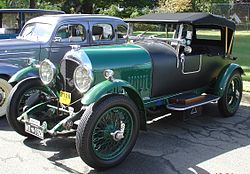
The 1926 Bentley Speed Six Tourer is a famous British car of the vintage era.

History

History of the automobile
The vintage era in the automotive world was a time of transition. The car started off in 1919 as still something of a rarity, and ended up, in 1930, well on the way towards ubiquity. In fact, automobile production at the end of this period was not matched again until the 1950s. In the intervening years, most industrialized states built nationwide road systems with the result that, towards the end of the period, the ability to negotiate unpaved roads was no longer a prime consideration of automotive design. In today's terms, a vintage car is defined the same as a classic.

Cars became much more practical, convenient and comfortable during this period. Car heating was introduced, as was the in-car radio. Four-wheel braking from a common foot pedal was introduced, as was the use of hydraulically actuated brakes. Power steering was also an innovation of this era. Towards the end of the vintage era, the system of octane rating of fuel was introduced, allowing comparison between fuels. In 1923 the gasoline additive Ethyl made its debut at the Indy 500 that resulted in a boost in octane from the 50's to the 80's In the United States drive-in restaurants were introduced as well as suburban shopping centers and motels.

Alfred P. Sloan and Harley Earl of General Motors, and Walter P. Chrysler capitalized on advertising the automobile’s role in the life of the consumer for more than just the utilitarian value compared with the horse. The stock market crash of 1929 started the layoff of automotive workers and many new companies went bankrupt but over two million cars were still produced in 1929 and 1930. Horatio Earle, known as the "Father of good roads" had proposed the government create an Interstate highway system in 1902 and in 1909 built the World's first mile of concrete road on Woodward Avenue in Detroit.
Federal road and highway acts

The Federal Aid Road Act of 1916 was the first federal highway act. War and lack of funding hampered any positive results of this act. The Federal Aid Highway Act of 1921 (Phipps Act) started a 50/50 matching fund to states for road building and resulted in the creation of new and improved roads. During this period as well as the car adapting to society, there were better roads, and society began to adapt to the car. Dwight D. Eisenhower participated in the highly publicized Transcontinental Motor Convoy in 1919 and after becoming President the experience influenced the Federal Aid Highway Act of 1956 that included 41,000 miles of highways.

The depression of 1920-1921
The end of World War I brought about the "Depression of 1920-21" with a better than 20 percent inflation rate, a 7 percent Fed discount loan rate, and an 11.7 percent unemployment rate, and many companies went bankrupt and the automotive industry was decimated.The Big Three

From 1919 to 1929, many dramatic changes took place. General Motors went into a financial crisis that lasted until after Alfred Sloan became president in 1923. Hudson produced the Essex in 1919 that, by 1925, had propelled the company to third in total sales behind Ford and Chevrolet. Ford was in the process of building a new plant, buying back stock, and began an 18-month process of tooling-up to replace the Model T with the Model A in 1927. In 1921 Maxwell failed and Walter P. Chrysler, formerly of General Motors, was brought in to reorganize it and, in 1925, the Chrysler Corporation was formed. With Ford out for a period, Chrysler was able to produce and market the low-priced Plymouth in 1928, and bought out the Dodge Brothers, also in 1928, resulting in "The Big Three" more recently known as the "Detroit Three". During this time Britain had six major manufacturers instead of three: Morris, Austin, Standard, Rootes, Ford of Britain, and Vauxhall. There were other automakers that made it past the 1920-1921 depression only to fail during the Great Depression. Among smaller automobile manufacturers was Franklin that produced high-quality luxury cars during the 1919 to 1930 vintage era.

Safety issues
Antique automobiles and early to middle era classic cars do not have the safety features that are standard on modern cars. The most rudimentary of safety features, front wheel brakes and hydraulic brakes, began appearing on cars in the 1920s and 1930s respectively. The seat belt, appeared in the sixties and became mandated by federal seat belt legislation in the United States in 1968. However, the merits of adding seat belts to vintage cars is debatable; Chuck Conrad, president of the Des Plaines, Illinois chapter of the Classic Car Club of America stated, "Bolting yourself down to a 70-year-old piece of wood isn't really going to stop anything.". Newer mandated safety features, generally apply to production of vehicles after the laws take effect so vehicles built before any new laws are grandfathered, particularly in the United States.

Collecting
For the average person car collecting is a hobby. A person usually has a fascination with a certain vehicle or a history with one so seeks a certain make or model. Finding an antique car at an affordable price is not hard but can be relatively expensive depending on the condition or the desired end result. The less work required on a vehicle equates to a higher price. The more work required means a cheaper initial cost, but more in the long run, and a person's level of restoration experience plays an important part.

Investment
Comedian and avid car collector Jay Leno stated, "Any car can be a collector car, if you collect it. "Antique car collecting as an investment can be rewarding but most serious investment collectors seek rare or exotic cars and original unmodified cars hold a more stable price. Collecting as an investment requires expertise beyond enthusiast collecting and the standard of quality is far higher as well as a need for investment protection such as storage and maintenance. A short-term investment collector must be able to find a vehicle that has market value that is expected to rise in the foreseeable near future. A long-term investment collector would be less interested in any short-term value seeking to capitalize on an expected value rise over a period of years and a vehicle must have certain intrinsic values that are common to other investors or collectors of both short and long term.

Rarity
Antique vehicles have a higher value according to the rarity that usually (but not always) resulted in some reason for a lack of numbers at production. Certain year and model cars became popular to turn into hot rods thus destroying the original condition. Other models were produced in such quantities that the price is still not inflated. Market trend is an important part in the price of a vintage car. An "almost" original and in perfect shape model A that was abundantly produced can be purchased for $20,000.00. A collector as an investor would have to know the potential market and have a belief that the future market will bring a return on an investment. Many collectors also tend to have a direction or like for certain vehicles that reflects their expertise.

Senin, 21 September 2015

Classic car


Classic car
A classic car is an older automobile; the exact definition varies around the world. The common theme is of an older car with enough historical interest to be collectable and worth preserving or restoring rather than scrapping. The Classic Car Club of America maintains that a car must be between 30 and 49 years old to be a classic, while cars between 50 and 99 fall into a pre-antique class, and cars 100 years and older fall into the Antique Class. In the UK, 'classic cars' range from veteran (pre–First World War), to vintage (1919–1930), to post-vintage (1930s). Post–Second World War classic cars are not so precisely defined.
Classic Car Club of America
The Classic Car Club of America defines a CCCA Classic as follows:

    A CCCA Classic is a "fine" or "distinctive" automobile, either American or foreign built, produced between 1925 and 1948. Other factors, including engine displacement, custom coachwork and luxury accessories, such as power brakes, power clutch, and "one-shot" or automatic lubrication systems, help determine whether a car is considered a Classic.

Any member may petition for a vehicle to join the list. Such applications are carefully scrutinized and rarely are a new vehicle type admitted.
This rather exclusive definition of a classic car is not universally followed, however, and this is acknowledged by the CCCA: while it still maintains the true definition of "classic car" it is, it generally uses terms such as CCCA Classic or the trademarked Full Classic to avoid confusion.
 
United States legal definition
Legally, most states have time-based rules for the definition of "classic" for purposes such as antique vehicle registration; for example, Most states define it as "A motor vehicle, but not a reproduction thereof, manufactured at least 20 years prior to the current year which has been maintained in or restored to a condition which is substantially in conformity with manufacturer specifications and appearance."

Despite this, at many American classic car shows, automobiles typically range from the thirties to sixties. Examples of cars at such shows include the Chevrolet Bel-Air, Ford T-Bucket, Dodge Charger, Chevrolet Deuce Coupe, and 1949 Ford. Meanwhile, the Concours D'Elegance car shows feature prestigious automobiles such as the Cadillac V16 or pre-1940 Rolls-Royce models. "Classic" cars at these shows seldom go beyond 1972. Any cars from 1973 onward are defined as "modern customs", "exotics", or "collectibles". For interest, cars such as the AMC Gremlin or Ford Pinto may be exhibited.

Americans are divided on the exact era in which a "classic car" can be identified. Many Americans divide automobiles by separate eras: horseless carriages (19th century experimental automobiles such as the Daimler Motor Carriage), antique cars (brass era cars such as the Ford Model T), and classic cars (typically 1930s cars such as the Cord 812 through the end of the muscle car period in the 1970s – a majority use the 1972 model year as the cutoff). The late seventies are disputed as being "classics", as the oil crisis of 1973 brought several now-infamous cars such as the Ford Pinto and AMC Gremlin. The 1980s are often viewed as the early modern period due to the rise of Japanese automakers such as Toyota and Nissan.

Antique Automobile Club of America
The Antique Automobile Club of America defines an antique car as 25 years or older. A Classic is defined as 20–49 years old.
 
United Kingdom
There is no fixed definition of a classic car. Two taxation issues do impact however, leading to some people using them as cutoff dates. All cars built before January 1, 1973, are exempted from paying the annual road tax vehicle excise duty. This is then entered on the licence disc displayed on the windscreen as "historic vehicle" (if a car built before this date has been first registered in 1973 or later, then its build date would have to be verified by a recognised body such as British Motor Heritage Foundation to claim tax-free status). HM Revenue and Customs define a classic car for company taxation purposes as being over 15 years old and having a value in excess of £15,000.
Additionally, popular acclaim through a large number of classic car magazines plays an important role in whether a car comes to be regarded as a classic. It is all subjective and a matter of opinion. The elimination of depreciation is a reason for buying a classic car; this is a major cost of owning a modern car. Picking 'future classics' that are current 'bangers' is a pastime of people into classic cars in the UK. Successfully picking and buying one can result in a profit for the buyer as well as providing transport. An immaculate well cared for prestige model with high running costs that impacts its value, but is not yet old enough to be regarded as a classic, could be a good buy, for example. A change in the taxation class is due to take force in April 2014, by moving the cut-off date of the historic vehicle class from January 1973 to January 1974, thus including all cars registered and built in 1973 as historic.

Modern classics
These vehicles are generally older, ranging from 15 to 25 years, but are usually not accepted as classics according to the Antique Automobile Club of America. In the UK the Modern Classic definition is open to the discretion often by Insurance Brokers and Insurance Companies who regard a Modern Classic as a vehicle that is considered collectible regardless of age. The usage of the vehicle limited to recreational purposes and/or restricted mileage is also taken into account.
 
Classic car styling
There was a worldwide change in styling trends in the immediate years after the end of World War II. The 1946 Crosley and Kaiser-Frazer, for example, changed the traditional discrete replaceable-fender treatment. From this point on, automobiles of all kinds became envelope bodies in basic plan. The CCCA term, "Antique Car" has been confined to "the functionally traditional designs of the earlier period" (mostly pre-war). They tended to have removable fenders, trunk, headlights, and a usual vertical grill treatment. In a large vehicle, such as a Duesenberg, Pierce-Arrow, or in a smaller form, the MG TC, with traditional lines, might typify the CCCA term. Another vehicle might be a classic example of a later period but not a car from the "classic period of design", in the opinion of the CCCA.
 
Safety
Drivers of classic cars must be especially careful. Classic cars often lack what are now considered basic safety features, such as seat belts, crumple zones or rollover protection. On September 10, 2009, ABC News 'Good Morning America' and 'World News' showed a U.S. Insurance Institute of Highway Safety crash test of a 2009 Chevrolet Malibu in an offset head-on collision with a 1959 Chevrolet Bel Air sedan. It dramatically demonstrated the effectiveness of modern car safety design, over 1950s X-frame design, particularly of rigid passenger safety cells and crumple zones. The 1959 Chevrolets used an X frame design which lacked structural rigidity; had the IIHS used a pre-1958 Chevrolet with a Unibody design, the results would have been much better. Vehicle handling characteristics (particularly steering and suspension) and brake performance are likely to be poorer than current standards, hence requiring greater road-awareness on the part of the driver. In certain areas of the United States, using a classic car as a daily vehicle is strongly discouraged and may even be considered illegal in some places.

Retro-styled (color-coded with chromed buckles) 2-point and 3-point seat (safety) belts are manufactured according to Federal Motor Vehicle Safety Standards (FMVSS). However, most classic car bodies (manufactured before the late 1960s) did not include safety belts as standard equipment, and do not include readily available reinforced mounting points, on the vehicle body, therefore it can be problematic to install such equipment properly: specific studies and calculations should be performed before any attempts. Proper installation is critical, which means locating attachment points on the body/frame, assuring the strength by proper reinforcement, and following the seat belt installation instructions properly to reduce the risk of malfunction or failure. Some classic car owners are reluctant to retrofit seat belts for the loss of originality this modification implies. There have also been instances of cars losing points at shows for being retrofitted with seat belts.

Fitting modern tires is also a suggestion to improve the handling. However, most modern tires may be much wider and have a lower profile than those used on classic cars when new, therefore they may interfere with suspension elements and the tire walls may become damaged. The suspension of a classic car may not be suitable for radial ply tyres, having been designed to only accommodate bias ply tires. Narrow classic car wheels may have been designed for narrow high profile tube tires and not be suitable for modern tubeless radial tires. Another problem with modern tires on classic cars is that increased grip requires increased steering effort; many classic cars do not come with power steering. Many major tire companies have dedicated classic car tire marketing departments and will be able to give expert technical advice to address all these issues. It is important to know how radial tires will affect the performance of a car originally fitted with bias-ply tires, and the considerations needed to compensate for the differences.

Upgrading braking using either bespoke parts, parts produced by the vehicle's manufacturer, from later versions of the same model or later models that may be compatible with minor modification, is an effective method of improving safety. Popular examples include drum brake to disc brake conversions, or adding a vacuum servo to cars with front disc brakes that did not originally have one.

Despite these concerns, classic cars are involved in significantly fewer accidents.

Mitsubishi Motors

Mitsubishi Motors
Mitsubishi Motors Corporation Hepburn: Mitsubishi is a multinational automotive manufacturer headquartered in Minato, Tokyo, Japan. In 2011, Mitsubishi Motors was the sixth biggest Japanese automaker and the sixteenth biggest worldwide by production. It is part of Mitsubishi keiretsu, formerly the biggest industrial group in Japan, and was formed in 1970 from the automotive division of Mitsubishi Heavy Industries.

History
 
Workers at Mitsubishi Shipbuilding Co., Ltd alongside one of the prototype Mitsubishi Model A automobiles.

Mitsubishi's automotive origins date back to 1917, when the Mitsubishi Shipbuilding Co., Ltd. introduced the Mitsubishi Model A, Japan's first series-production automobile. An entirely hand-built seven-seater sedan based on the Fiat Tipo 3, it proved expensive compared to its American and European mass-produced rivals, and was discontinued in 1921 after only 22 had been built.

In 1934, Mitsubishi Shipbuilding was merged with the Mitsubishi Aircraft Co., a company established in 1920 to manufacture aircraft engines and other parts. The unified company was known as Mitsubishi Heavy Industries (MHI), and was the largest private company in Japan. MHI concentrated on manufacturing aircraft, ships, railroad cars and machinery, but in 1937 developed the PX33, a prototype sedan for military use. It was the first Japanese-built passenger car with full-time four-wheel drive, a technology the company would return to almost fifty years later in its quest for motorsport and sales success.

Post-war era
Immediately following the end of the Second World War, the company returned to manufacturing vehicles. Fuso bus production resumed, while a small three-wheeled cargo vehicle called the Mizushima and a scooter called the Silver Pigeon were also developed. However, the zaibatsu (Japan's family-controlled industrial conglomerates) were ordered to be dismantled by the Allied powers in 1950, and Mitsubishi Heavy Industries was split into three regional companies, each with an involvement in motor vehicle development: West Japan Heavy-Industries, Central Japan Heavy-Industries, and East Japan Heavy-Industries.

East Japan Heavy-Industries began importing the Henry J, an inexpensive American sedan built by Kaiser Motors, in knockdown kit (CKD) form in 1951, and continued to bring them to Japan for the remainder of the car's three-year production run. The same year, Central Japan Heavy-Industries concluded a similar contract with Willys (now owned by Kaiser) for CKD-assembled Jeep CJ-3Bs. This deal proved more durable, with licensed Mitsubishi Jeeps in production until 1998, thirty years after Willys themselves had replaced the model.

By the beginning of the 1960s Japan's economy was gearing up; wages were rising and the idea of family motoring was taking off. Central Japan Heavy-Industries, now known as Shin Mitsubishi Heavy-Industries, had already re-established an automotive department in its headquarters in 1953. Now it was ready to introduce the Mitsubishi 500, a mass market sedan, to meet the new demand from consumers. It followed this in 1962 with the Minica kei car and the Colt 1000, the first of its Colt line of family cars, in 1963. In 1964, Mitsubishi introduced its largest passenger sedan, the Mitsubishi Debonair as a luxury car primarily for the Japanese market, and was used by senior Mitsubishi executives as a company car.

West Japan Heavy-Industries (now renamed Mitsubishi Shipbuilding & Engineering) and East Japan Heavy-Industries (now Mitsubishi Nihon Heavy-Industries) had also expanded their automotive departments in the 1950s, and the three were re-integrated as Mitsubishi Heavy Industries in 1964. Within three years its output was over 75,000 vehicles annually. Following the successful introduction of the first Galant in 1969 and similar growth with its commercial vehicle division, it was decided that the company should create a single operation to focus on the automotive industry. Mitsubishi Motors Corporation (MMC) was formed on April 22, 1970 as a wholly owned subsidiary of MHI under the leadership of Tomio Kubo, a successful engineer from the aircraft division.

The logo of three red diamonds, shared with over forty other companies within the keiretsu, predates Mitsubishi Motors itself by almost a century. It was chosen by Iwasaki Yatarō, the founder of Mitsubishi, as it was suggestive of the emblem of the Tosa Clan who first employed him, and because his own family crest was three rhombuses stacked atop each other. The name Mitsubishi is a compound of mitsu ("three") and hishi (literally, "water chestnut", often used in Japanese to denote a diamond or rhombus).

Chrysler connection
1970s

Part of Mr. Kubo's expansion strategy was to increase exports by forging alliances with well-established foreign companies. Therefore, in 1971 MHI sold U.S. automotive giant Chrysler a 15 percent share in the new company. Thanks to this deal, Chrysler began selling the Galant in the United States as the Dodge Colt (which was the first rebadged Mitsubishi product sold by Chrysler), pushing MMC's annual production beyond 250,000 vehicles. In 1977, the Galant was sold as the Chrysler Sigma in Australia.
A 1973 Mitsubishi Galant, the basis for the company's first captive import deal with Chrysler.

By 1977, a network of "Colt"-branded distribution and sales dealerships had been established across Europe, as Mitsubishi sought to begin selling vehicles directly. Annual production had by now grown from 500,000 vehicles in 1973 to 965,000 in 1978, when Chrysler began selling the Galant as the Dodge Challenger and the Plymouth Sapporo. However, this expansion was beginning to cause friction; Chrysler saw their overseas markets for subcompacts as being directly encroached by their Japanese partners, while MMC felt the Americans were demanding too much say in their corporate decisions.
 
1980s
Mitsubishi finally achieved annual production of one million cars in 1980, but by this time its ally was not so healthy; As part of its battle to avoid bankruptcy, Chrysler was forced to sell its Australian manufacturing division to MMC that year. The new Japanese owners renamed it Mitsubishi Motors Australia Ltd (MMAL).

In 1982, the Mitsubishi brand was introduced to the American market for the first time. The Tredia sedan, and the Cordia and Starion coupés, were initially sold through seventy dealers in 22 states, with an allocation of 30,000 vehicles between them. This quota, restricted by mutual agreement between the two countries' governments, had to be included among the 120,000 cars earmarked for Chrysler. Toward the end of the 1980s, as MMC initiated a major push to increase its U.S. presence, it aired its first national television advertising campaign, and made plans to increase its dealer network to 340 dealers.

In 1986 Mitsubishi reached an agreement with Liuzhou Automotive to assemble their Minicab kei van and truck there, making Mitsubishi the third Japanese manufacturer (after Daihatsu and Suzuki) to begin assembly in China. Before receiving government approval for this project, Mitsubishi had had to express contrition over "defective" Mitsubishi trucks imported to China in 1984 and 1985.    By 1989, Mitsubishi's worldwide production, including its overseas affiliates, had reached 1.5 million units.

Diamond-Star Motors
Despite the ongoing tensions between Chrysler and Mitsubishi, they agreed to unite in a vehicle manufacturing operation in Normal, Illinois. The 50/50 venture provided a way to circumvent the voluntary import restrictions, while providing a new line of compact and subcompact cars for Chrysler. Diamond-Star Motors (DSM)—from the parent companies' logos: three diamonds (Mitsubishi) and a pentastar (Chrysler)—was incorporated in October 1985, and in April 1986 ground was broken on a 1.9 million square-foot (177,000 m²) production facility. In 1987, the company was selling 67,000 cars a year in the U.S., but when the plant was completed in March 1988 it offered an annual capacity of 240,000 vehicles. Initially, three platform-sharing compact 2+2 coupés were released, the Mitsubishi Eclipse, Eagle Talon and Plymouth Laser, with other models being introduced in subsequent years.

1988 IPO
Mitsubishi Motors went public in 1988, ending its status as the only one of Japan's eleven auto manufacturers to be privately held. Mitsubishi Heavy Industries agreed to reduce its share to 25 percent, retaining its position as largest single stockholder. Chrysler, meanwhile, increased its holding to over 20 percent. The capital raised by this initial offering enabled Mitsubishi to pay off part of its debts, as well as to expand its investments throughout south-east Asia where it was by now operating in the Philippines, Malaysia, and Thailand.

1990s
Hirokazu Nakamura became president of Mitsubishi in 1989 and steered the company in some promising directions, with the advent of the Japanese asset price bubble "market correction" that led to the Lost Decade as a result of the Plaza Accord agreement signed in 1985. Sales of the company's new Pajero were bucking conventional wisdom by becoming popular even in the crowded streets of Japan.

It was heavily rumored that Mitsubishi Motors intended a hostile acquisition of Honda by Japanese media in 1992 and 1993. While Mitsubishi was riding high off of profitable vehicles such as the Diamante and Pajero, Honda was caught off-guard with the SUV and truck boom and was losing focus after the illness and later death of its founder. However, Honda CEO Nobuhiko Kawamoto took drastic steps, such as exiting Formula 1 and discontinuing unprofitable vehicles to avert a Mitsubishi takeover, which proved effective.

Although sales of SUVs and light trucks were booming in the U.S., Japan's car manufacturers dismissed the idea that such a trend could occur in their own country. Nakamura, however, increased the budget for sport utility product development, and his gamble paid off; Mitsubishi's wide line of four-wheel drive vehicles, from the Mitsubishi Pajero Mini kei car to the Delica Space Gear passenger van, rode the wave of SUV-buying in Japan in the early to mid-1990s, and Mitsubishi saw its overall domestic share rise to 11.6 percent in 1995.
 
Independence
In 1991, Chrysler sold its equity stake in Diamond-Star Motors to its partner, and from then on they continued to share components and manufacturing on a contractual basis only. Chrysler decreased its interest in Mitsubishi Motors to less than three percent in 1992, and announced its decision to divest itself of all its remaining shares on the open market in 1993. The two companies nevertheless continued their close alliance, with Chrysler supplying some parts for engines and transmissions for DSM, and Mitsubishi marketing Chrysler products overseas and supplying engines for Chrysler minivans and cars.

DSM was officially renamed Mitsubishi Motor Manufacturing of America on July 1, 1995, and Mitsubishi Motors North America, Manufacturing Division in 2002.

DaimlerChrysler
Two years after the merger of Daimler and Chrysler to form DCX in 1998, the U.S.-German conglomerate paid US$1.9 billion for a controlling 34 percent of MMC, in an effort to fulfil chairman Jürgen Schrempp's vision of a "Welt AG" ("world corporation"). The price reflected a US$200 million discount on the originally agreed figure, caused by the public disclosure of the defect cover-up scandal. In March 2001 it increased its stake to 37.3 percent when it acquired Volvo's stake in MMC's truck-making operations, further boosting Mercedes' share of a market it already dominated. However, boardroom wrangling at DCX in April 2004 prevented them offering financial assistance as Mitsubishi attempted to reduce its crippling debts. When a US$4 billion rescue package was agreed with Tokyo-based Phoenix Capital in May 2004, DCX's stake was reduced to 23 percent, and further recapitalisations subsequently diluted the holding to 12.4 percent. Finally, on November 11, 2005, the remaining stock was sold for US$1.1 billion—an US$800 million loss in five years.

New major stockholder Phoenix Capital followed suit the following month, selling all but 50 million of its 575 million shares to JPMorgan on December 9, 2005. Once again, the investment bank offloaded their purchase within a few days for tens of millions in profit. In both cases, the eventual buyers were part of the Mitsubishi keiretsu, returning MMC to Japanese ownership.

Examples of products resulted from this alliance are the Smart Forfour, based on the platform of the Mitsubishi Colt and produced at the NedCar factory in Netherlands (owned by Mitsubishi Motors), and the Mitsubishi Raider, based on the platform of the Dodge Dakota. Another post-alliance example is the production of the Mitsubishi Triton performed at the Mercedes-Benz South Africa (MBSA) plant (owned by Daimler AG) since October 2008.

Ford of Europe


History
Ford of Europe was founded in 1967 on the merger of the British and German divisions of the Ford Motor Company. The front-engined Ford Transit range of panel vans launched in 1965, was the first formal co-operation between the two entities, simultaneously developed to replace the German Ford Taunus Transit and the British Ford Thames 400E. Prior to this, the two companies avoided marketing their vehicles in one another's domestic markets, and in much of the rest of western Europe were direct competitors, with totally separate product lines, despite being owned by the same American parent, in a similar manner to General Motors’ Opel and Vauxhall subsidiaries at the same time - indeed GM followed Ford's precedent in the 1970s by merging the operations of Opel and Vauxhall into General Motors Europe.

1967–1973: Cortina and Escort

The first new model launched after the creation of Ford of Europe was the Escort built in England from October 1967, and launched to market later that year. The Escort was a rear-wheel drive small family saloon that took the place of the British Anglia range and was built in both Britain and, from 1970, Germany. It was first available as a two-door saloon and later in estate, van and four-door saloon bodystyles. Power came from 950 cc, 1100 cc and 1300 cc petrol engines. Later there was also a 2000 cc unit which came in the RS2000 performance version and was capable of 110 mph (180 km/h). It quickly became popular with buyers, outselling in the UK key competitors from BMC (later British Leyland), Vauxhall (Opel in Germany) and the Rootes Group. The Escort would never achieve such dominance in Europe's largest auto market, but nevertheless took significant market share from the Opel and Volkswagen competitors of the time.

Ford Europe's second new car launch was the Capri sporting coupé in 1969. Loosely based on Ford UK's rear-wheel drive Mk II Cortina platform, it came with engines ranging from 1300 cc to 3000 cc and was made in Britain and Germany (with a different range of German V4 and V6 engines), and quickly became popular with buyers who wanted something different from BMC's MGB GT and the Rootes Group's Sunbeam Alpine.

August 1970 saw the launch of the British Ford Cortina Mk III and its German cousin, a the Taunus (replacing the Taunus 12M & 15M). The British and German models were based on the same platform, but had different sheet metal and used engines from their home countries, though both models could be had with the new German-built 2000cc OHC petrol engine. By 1972 the Cortina was the best-selling car in Britain.In the Spring of 1972, Ford Europe replaced their top of the range models from Britain (Zephyr/Zodiac) and Germany (17M/20M/26M) with the Consul and Granada (large sedan, estate and coupé) which was aimed directly at the Opel Rekord, Rover P6, Audi 100 and Triumph 2000. It quickly outsold its rivals in many countries and in 1973 was the tenth best-selling car in Britain. Like the Capri and Cortina/Taunus models, the early Consuls and Granadas were built in both Britain and Germany, each with a unique range of national engines.

1974–1980: MK 2 Escort and New Fiesta


A revised Capri II arrived in early 1974, which saw a hatchback replacing the traditional "boot".

Ford launched a Ford Escort (Europe) at the start of 1975, with a heavily restyled exterior and a less cramped interior, but an almost identical mechanical design. The entry-level 950 cc engine, which was rare in any country, was discontinued.

In 1975, Ford overtook British Leyland (the combine which included Austin, Morris and Rover) as the most popular make of car in the United Kingdom.

1976 saw Ford Europe enter the mini-car market with its first ever-front model to have a hatchback and front-wheel drive. The Fiesta MK1 was built at the company's new Valencia plant in Spain, and came with 950 cc, 1100 cc and 1300 cc petrol engines. It was later available with a 1600 cc unit for the sporty XR2 version. Britain and most of the rest of Europe took to it straight away and it was quickly among the best-selling cars in most of the continent, fighting off competition from the Volkswagen Polo, Citroën Visa, Vauxhall Chevette and Peugeot 104.

1976 also saw the launch of the Cortina MK4 and Taunus, that continued to top the sales charts in Britain and fight off competition from a growing number of equally competent rivals, namely the Vauxhall Cavalier/Opel Ascona and Chrysler Alpine.

Ford launched the Mk II Granada range in September 1977. In 1976, all Granada production had been concentrated to Cologne, Germany. The Consul badge was abandoned in 1975.

The Mk III Capri sporting coupé arrived in 1978. By now Capri production was also concentrated at Cologne.

1980 saw one of the most important car launches in Ford's history. The MK3 Escort went on sale across Britain and Europe in October, with its ultra-modern styling and updated front-wheel drive mechanical layout. It was also available as a hatchback for the first time, with no saloon version on offer. The 2000 cc engine was dropped, and the range-topping Escort was now the XR3 which came with a fuel-injected 1600 cc unit.

Ford Motor Company


Henry Ford's first attempt at a car company under his own name was the Henry Ford Company on November 3, 1901, which became the Cadillac Motor Company on August 22, 1902, after Ford left with the rights to his name. The Ford Motor Company was launched in a converted factory in 1903 with $28,000 in cash from twelve investors, most notably John and Horace Dodge (who would later found their own car company). During its early years, the company produced just a few cars a day at its factory on Mack Avenue in Detroit, Michigan. Groups of two or three men worked on each car, assembling it from parts made mostly by supplier companies contracting for Ford. Within a decade the company would lead the world in the expansion and refinement of the assembly line concept; and Ford soon brought much of the part production in-house in a vertical integration that seemed a better path for the era.

Henry Ford was 39 years old when he founded the Ford Motor Company, which would go on to become one of the world's largest and most profitable companies. As one of the largest family-controlled companies in the world, the Ford Motor Company has been in continuous family control for over 100 years.

After the first modern automobile was already created in the year 1886 by German inventor Carl Benz (Benz Patent-Motorwagen), more efficient production methods were needed to make the automobile affordable for the middle-class; which Ford contributed to, for instance by introducing the first moving assembly line in 1913.

In 1908 Ford introduced the first engine with a removable cylinder head, in the Model T. In 1927, Ford introduced the Model A, the first car with safety glass in the windshield. Ford launched the first low priced V8 engine powered car in 1932.

The creation of a scientific laboratory in Dearborn, Michigan in 1951, doing unfettered basic research, led to Ford's unlikely involvement in superconductivity research. In 1964 Ford Research Labs made a key breakthrough with the invention of a superconducting quantum interference device or SQUID.

Ford offered the Lifeguard safety package from 1956, which included such innovations as a standard deep-dish steering wheel, optional front, and, for the first time in a car, rear seatbelts, and an optional padded dash. Ford introduced child-proof door locks into its products in 1957, and in the same year offered the first retractable hardtop on a mass-produced six-seater car. The Ford Mustang was introduced in 1964. In 1965 Ford introduced the seat belt reminder light.

With the 1980s, Ford introduced several highly successful vehicles around the world. During the 1980s, Ford began using the advertising slogan, "Have you driven a Ford, lately?" to introduce new customers to their brand and make their vehicles appear more modern. In 1990 and 1994 respectively, Ford also acquired Jaguar Cars and Aston Martin. During the mid- to late 1990s, Ford continued to sell large numbers of vehicles, in a booming American economy with a soaring stock market and low fuel prices.

With the dawn of the new century, legacy healthcare costs, higher fuel prices, and a faltering economy led to falling market shares, declining sales, and diminished profit margins. Most of the corporate profits came from financing consumer automobile loans through Ford Motor Credit Company.
21st century
William Clay Ford, Jr., great-grandson of Henry Ford, serves as the executive chairman at the board of Ford Motor Company.

By 2005, both Ford and GM's corporate bonds had been downgraded to junk status, as a result of high U.S. health care costs for an aging workforce, soaring gasoline prices, eroding market share, and an over dependence on declining SUV sales. Profit margins decreased on large vehicles due to increased "incentives" (in the form of rebates or low interest financing) to offset declining demand. In the latter half of 2005, Chairman Bill Ford asked newly appointed Ford Americas Division President Mark Fields to develop a plan to return the company to profitability. Fields previewed the Plan, named The Way Forward, at the December 7, 2005 board meeting of the company and it was unveiled to the public on January 23, 2006. "The Way Forward" included resizing the company to match market realities, dropping some unprofitable and inefficient models, consolidating production lines, closing 14 factories and cutting 30,000 jobs.

Ford moved to introduce a range of new vehicles, including "Crossover SUVs" built on unibody car platforms, rather than more body-on-frame chassis. In developing the hybrid electric powertrain technologies for the Ford Escape Hybrid SUV, Ford licensed similar Toyota hybrid technologies to avoid patent infringements. Ford announced that it will team up with electricity supply company Southern California Edison (SCE) to examine the future of plug-in hybrids in terms of how home and vehicle energy systems will work with the electrical grid. Under the multimillion-dollar, multi-year project, Ford will convert a demonstration fleet of Ford Escape Hybrids into plug-in hybrids, and SCE will evaluate how the vehicles might interact with the home and the utility's electrical grid. Some of the vehicles will be evaluated "in typical customer settings", according to Ford.

William Clay Ford Jr., great-grandson of Henry Ford (and better known by his nickname "Bill"), was appointed Executive Chairman in 1998, and also became Chief Executive Officer of the company in 2001, with the departure of Jacques Nasser, becoming the first member of the Ford family to head the company since the retirement of his uncle, Henry Ford II, in 1982. Upon the retirement of President and Chief Operation Officer Jim Padilla in April 2006, Bill Ford assumed his roles as well. Five months later, in September, Ford named Alan Mulally as President and CEO, with Ford continuing as Executive Chairman. In December 2006, the company raised its borrowing capacity to about $25 billion, placing substantially all corporate assets as collateral. Chairman Bill Ford has stated that "bankruptcy is not an option". Ford and the United Auto Workers, representing approximately 46,000 hourly workers in North America, agreed to a historic contract settlement in November 2007 giving the company a substantial break in terms of its ongoing retiree health care costs and other economic issues. The agreement included the establishment of a company-funded, independently run Voluntary Employee Beneficiary Association (VEBA) trust to shift the burden of retiree health care from the company's books, thereby improving its balance sheet. This arrangement took effect on January 1, 2010. As a sign of its currently strong cash position, Ford contributed its entire current liability (estimated at approximately US$5.5 billion as of December 31, 2009) to the VEBA in cash, and also pre-paid US$500 million of its future liabilities to the fund. The agreement also gives hourly workers the job security they were seeking by having the company commit to substantial investments in most of its factories.

The automaker reported the largest annual loss in company history in 2006 of $12.7 billion, and estimated that it would not return to profitability until 2009. However, Ford surprised Wall Street in the second quarter of 2007 by posting a $750 million profit. Despite the gains, the company finished the year with a $2.7 billion loss, largely attributed to finance restructuring at Volvo.

On June 2, 2008, Ford sold its Jaguar and Land Rover operations to Tata Motors for $2.3 billion.

During Congressional hearings held in November 2008 at Washington D.C., and in a show of support, Ford's Alan Mulally stated that "We at Ford are hopeful that we have enough liquidity. But we also must prepare ourselves for the prospect of further deteriorating economic conditions". Mulally went on to state that "The collapse of one of our competitors would have a severe impact on Ford" and that Ford Motor Company's supports both Chrysler and General Motors in their search for government bridge loans in the face of conditions caused by the 2008 financial crisis. Together, the three companies presented action plans for the sustainability of the industry. Mulally stated that "In addition to our plan, we are also here today to request support for the industry. In the near-term, Ford does not require access to a government bridge loan. However, we request a credit line of $9 billion as a critical backstop or safeguard against worsening conditions as we drive transformational change in our company"  GM and Chrysler received government loans and financing through T.A.R.P. legislation funding provisions.

On December 19, the cost of credit default swaps to insure the debt of Ford was 68 percent the sum insured for five years in addition to annual payments of 5 percent. That meant $6.8 million paid upfront to insure $10 million in debt, in addition to payments of $500,000 per year. In January 2009, Ford reported a $14.6 billion loss in the preceding year, a record for the company. The company retained sufficient liquidity to fund its operations. Through April 2009, Ford's strategy of debt for equity exchanges erased $9.9 billion in liabilities (28% of its total) in order to leverage its cash position. These actions yielded Ford a $2.7 billion profit in fiscal year 2009, the company's first full-year profit in four years.

In 2012, Ford's corporate bonds were upgraded from junk to investment grade again, citing sustainable, lasting improvements.

On October 29, 2012, Ford announced the sale of its climate control components business, its last remaining automotive components operation, to Detroit Thermal Systems LLC for an undisclosed price.

On November 1, 2012, Ford announced that CEO Alan Mulally will stay with the company until 2014. Ford also named Mark Fields, the president of operations in Americas, as its new chief operating officer  Ford's CEO Mulally was paid a compensation of over $174 million in his previous seven years at Ford since 2006. The generous amount has been a sore point for some workers of the company.


The Ford Motor Company (commonly referred to as simply Ford) is an American multinational automaker headquartered in Dearborn, Michigan, a suburb of Detroit. It was founded by Henry Ford and incorporated on June 16, 1903. The company sells automobiles and commercial vehicles under the Ford brand and most luxury cars under the Lincoln brand. Ford also owns Brazilian SUV manufacturer, Troller, and Australian performance car manufacturer FPV. In the past it has also produced tractors and automotive components. Ford owns a 2.1% stake in Mazda of Japan, an 8% stake in Aston Martin of the United Kingdom, and a 49% stake in Jiangling of China. It also has a number of joint-ventures, two in China (Changan Ford Mazda and Ford Lio Ho), one in Thailand (AutoAlliance Thailand), one in Turkey (Ford Otosan), and one in Russia (Ford Sollers). It is listed on the New York Stock Exchange and is controlled by the Ford family, although they have minority ownership.

Ford introduced methods for large-scale manufacturing of cars and large-scale management of an industrial workforce using elaborately engineered manufacturing sequences typified by moving assembly lines; by 1914 these methods were known around the world as Fordism. Ford's former UK subsidiaries Jaguar and Land Rover, acquired in 1989 and 2000 respectively, were sold to Tata Motors in March 2008. Ford owned the Swedish automaker Volvo from 1999 to 2010. In 2011, Ford discontinued the Mercury brand, under which it had marketed entry-level luxury cars in the United States, Canada, Mexico, and the Middle East since 1938.

During the financial crisis at the beginning of the 21st century, it was close to bankruptcy, but it has since returned to profitability.

Ford is the second-largest U.S.-based automaker (preceded by General Motors) and the fifth-largest in the world based on 2010 vehicle sales. At the end of 2010, Ford was the fifth largest automaker in Europe. Ford is the eighth-ranked overall American-based company in the 2010 Fortune 500 list, based on global revenues in 2009 of $118.3 billion. In 2008, Ford produced 5.532 million automobiles and employed about 213,000 employees at around 90 plants and facilities worldwide.

The company went public in 1956 but the Ford family, through special Class B shares, still retain 40 percent voting rights.